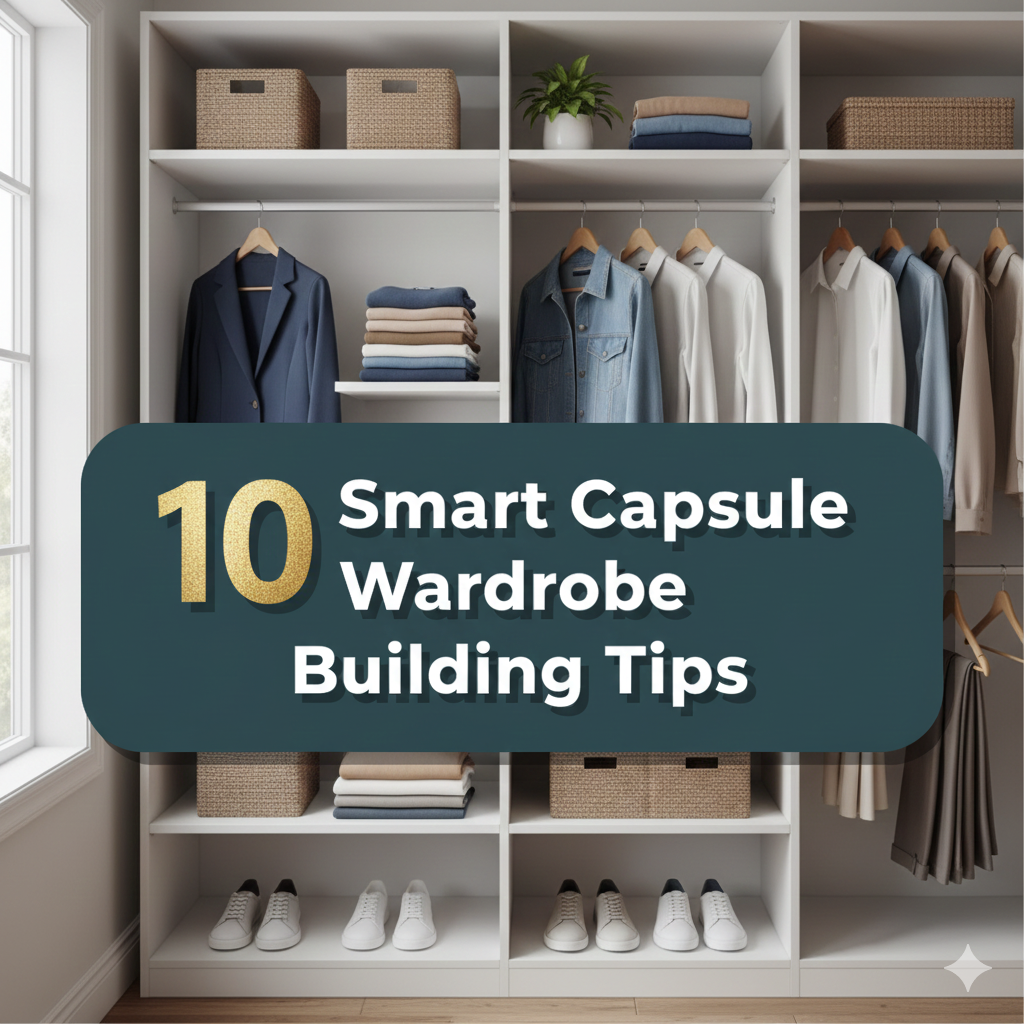
10 Tips for Building a Capsule Wardrobe That Actually Works
Imagine every morning opening your closet and knowing exactly what you’re going to put on. No stress. No mess. Just neat, arranged clothes that fit together beautifully.
That, in fact, is the magic of a capsule wardrobe.
More people are discarding overstuffed closets and opting for a more streamlined, sensible method of dressing. And the results? Less decision fatigue, money saved, and a wardrobe that actually reflects you.
Whether you’re starting from the ground up or trying to rescue a closet gone awry, this guide takes you through 10 actionable tips for building a capsule wardrobe that actually works. Each tip is something you can act on immediately — even if you’re a complete beginner.
Let’s get into it.
What Is a Capsule Wardrobe, Exactly?
A capsule wardrobe is a small, curated collection of clothing in which every item pairs beautifully with the others. The term was coined in the 1970s by fashion boutique owner Susie Faux. Fashion designer Donna Karan popularized it, successfully pitching the concept with her iconic “Seven Easy Pieces” collection in 1985.
The idea is simple: buy less clothing, but make every piece count.
A standard capsule wardrobe contains somewhere between 25 to 50 items, which can include tops, bottoms, outerwear, shoes, and accessories. Everything earns its place by being versatile, high-quality, and suited to your lifestyle.
The Life-Changing Magic of a Clutter-Free Closet
Before we jump into the tips, let’s talk about why this matters.
A disorganized closet is not only a waste of space — it’s a drain on time, energy, and money. Research on decision-making suggests that more options can lead to greater stress and less satisfaction, a phenomenon known as decision fatigue.
When your closet is a mess, getting dressed becomes a chore. When it’s curated, it becomes easy.
Here’s a side-by-side comparison of how a capsule wardrobe measures up to an overflowing closet:
| Feature | Traditional Closet | Capsule Wardrobe |
|---|---|---|
| Number of items | 100–300+ | 25–50 |
| Daily outfit stress | High | Low |
| Cost over time | High (impulse buys) | Lower (intentional buys) |
| Items actually worn | 20% | 90–100% |
| Closet organization | Difficult | Easy to maintain |
| Environmental impact | Higher | Lower |
The numbers speak for themselves. Now, let’s build yours.
Tip 1: Begin With a Complete Closet Audit
Pull Everything Out First
You need to know what you already have before adding a single new item. That means taking everything out of your closet — yes, all of it, including the stuff in the back.
Spread everything out across your bed or floor and sort into four piles:
- Keep — Things you love and actually wear
- Give away — In good condition, but not for you
- Toss — Worn, stained, or damaged
- Uncertain — Set these aside in a holding pile for 30 days
Ask the Hard Questions
For every item, ask yourself:
- Have I worn this in the past 12 months?
- Does it fit me well right now?
- Does it give me confidence?
- Does it work with at least three other things I own?
If the answer to most of those questions is “no,” it’s time to let go.
A closet audit is the essential first step to building a capsule wardrobe. You cannot build something clean on top of something cluttered.
Tip 2: Know Your Personal Style Before You Start
Don’t Copy Someone Else’s Capsule
There are plenty of beautiful capsule wardrobes on Pinterest and Instagram — but they belong to someone else’s life, not yours.
Before selecting any items, clarify your personal style. Reflect on your daily habits. Do you work in an office most of the week? Do you work from home? Are you frequently outdoors?
Your capsule wardrobe should reflect your actual life, not a fantasy version of it.
Create a Simple Style Profile
Try this exercise. Answer these five questions:
- What words do I want my appearance to reflect? (e.g., classic, casual, bold, minimal)
- What colors do I naturally gravitate towards?
- What am I most comfortable wearing?
- Who do I look up to style-wise, and why?
- What kinds of events do I dress for most often?
Use these answers as a filter for every purchase decision going forward. This one step alone can save you dozens of impulse purchases that don’t belong in your true wardrobe.
Tip 3: Start With a Neutral Color Palette
Neutrals Are Your Best Friend
A strong neutral color palette is the foundation of every good capsule wardrobe. Neutrals are colors that work with just about everything.
Common capsule wardrobe neutrals include: black, white, gray, navy, beige/camel, olive, and brown.
When your base pieces share a color story, outfit-making feels almost automatic.
Add Accent Colors Sparingly
Once your neutrals are locked in, add one or two accent colors that you truly love. These might appear in a scarf, a blouse, or a pair of sneakers.
The key is restraint. Your accent colors should enhance your base, not compete with it.
Here’s a suggested proportion for a balanced capsule color palette:
| Category | Proportion |
|---|---|
| Neutral base colors | 70% |
| Complementary tones | 20% |
| Bold accent colors | 10% |
Staying within this ratio means everything in your closet plays well together.
Tip 4: Choose Versatility Over Quantity
The “Three Outfit Rule”
Here’s a useful test for any new piece you’re considering: can you style it at least three different ways?
If a shirt can only go with one pair of pants, it’s not a capsule wardrobe piece — it’s a specialty item. Pieces in a capsule wardrobe should be workhorses, not one-trick options.
Think in Outfits, Not Individual Pieces
As you assemble your capsule, think in full looks. A solid 33-item capsule can theoretically produce hundreds of outfit combinations.
Consider a simple example:
Base: 5 tops + 3 bottoms + 2 outerwear + 2 shoes 5 × 3 × 2 × 2 = 60 unique outfits
That’s two months of distinct outfits from just 12 pieces. Versatility multiplies your options without adding clutter.
Tip 5: Quality Over Quantity
Buy Less, Buy Better
One of the biggest mindset shifts in capsule wardrobe building is changing your relationship with spending. Let go of 10 cheaper things and replace them with 3 high-quality items.
Quality items hold up better, look better, and feel better. They don’t pill after two washes or lose their shape after a month.
How to Identify Quality Clothing
When shopping for capsule pieces, look for:
- Fabric content — Natural fibers like cotton, wool, linen, and silk tend to last longer
- Stitching — Clean, tight stitches with no loose threads
- Weight — A heavier fabric often indicates better construction
- Fit — Well-fitted garments look more polished regardless of price
- Brand reputation — Research how items perform over time
A $100 jacket worn 200 times costs $0.50 per wear. A $30 jacket that falls apart after 10 wears costs $3.00 per wear. Quality is nearly always the better financial decision.
Tip 6: Invest in Core Essential Pieces
The Foundation Items Every Capsule Needs
Some pieces are so useful they earn a place in nearly every capsule wardrobe. These are your foundational essentials — the items that anchor everything else.
Here’s a starter list of capsule wardrobe must-haves:
Tops:
- White button-down shirt
- Plain crew-neck or V-neck tee (2–3 neutral colors)
- Simple knitwear or sweater
Bottoms:
- Well-fitting jeans (dark wash is the most versatile)
- Tailored trousers or chinos
- A basic skirt or shorts (depending on lifestyle)
Outerwear:
- Classic trench coat or blazer
- A warm, neutral jacket for cooler months
Shoes:
- White or neutral sneakers
- Flats, loafers, or ankle boots
- One dressier option (dress shoes, oxfords, or Chelsea boots)
Accessories:
- A timeless leather or faux-leather bag
- A simple belt
- One or two scarves and minimal jewelry
These are the core pieces your capsule is built around. Everything else you bring in should link to and support these items.
Tip 7: Dress for the Life You Actually Have
Be Honest About How You Spend Your Time
This advice may seem obvious, but it’s one of the most frequently ignored principles when building a capsule wardrobe.
Many people hold onto cocktail dresses “just in case” or suits that haven’t been worn in three years — while lacking enough everyday casual pieces because those didn’t feel “worth investing in.”
Map Your Weekly Routine
Try this: write down what you actually do in a typical week and estimate how much time you spend in each setting.
| Setting | Time Spent (%) | Wardrobe Focus |
|---|---|---|
| Work/Office | 40% | Smart casual or formal |
| Home/Casual | 30% | Relaxed, comfortable basics |
| Social outings | 20% | Elevated casual or smart casual |
| Formal events | 10% | Dressy or occasion wear |
Use this breakdown to decide how many items belong in each category. If you work from home five days a week, you don’t need ten office blouses — but you do need great everyday basics.
Tip 8: Organize Your Closet to Match Your Capsule
A Capsule Wardrobe Needs a Capsule-Ready Closet
No matter how well your wardrobe is chosen, it will feel chaotic in a messy closet. After you’ve selected your pieces, take time to adjust the physical layout of your closet to complement them.
Closet Organization Tips That Work
- Sort by type — Group all tops together, all bottoms together, and so on
- Arrange by color — Within each category, go lightest to darkest
- Face everything the same direction — Makes items easier to find at a glance
- Use matching hangers — This simple switch makes any closet look more put together
- Give clothes breathing room — Items that aren’t crammed together are easier to see and reach
- Store seasonal items elsewhere — Keep your active closet lean
A neatly organized closet also helps you track what you actually wear. If something is never touched, it’s probably time to let it go.
Tip 9: Shop With Intention Going Forward
Break the Impulse Buying Habit
Impulse shopping is one of the greatest threats to a capsule wardrobe. Sales, trends, and the thrill of something new can quickly undo all your hard work.
Before buying anything, ask:
- Does this match my color palette?
- Can I wear it at least three different ways?
- Do I already own something similar?
- Will I still love this in two years?
- Does it genuinely fit my lifestyle?
Tactics to curb impulse buying:
- Add items to a wishlist and wait 72 hours before purchasing
- Unsubscribe from promotional emails
- Avoid shopping out of boredom or emotion
- Shop on a quarterly or seasonal basis rather than year-round
Consider Ethical and Sustainable Options
While shopping for new capsule pieces, it’s worth considering where your clothes come from. Fast fashion generates enormous environmental waste, and buying secondhand, thrifted, or sustainably made clothing supports both your wardrobe goals and the planet. For many capsule wardrobe enthusiasts, thrift stores are goldmines for affordable, high-quality staples.
Tip 10: Refresh Your Capsule Every Season
A Capsule Wardrobe Is Never “Finished”
Your style evolves. Your life changes. Your capsule wardrobe should too.
Many capsule wardrobe enthusiasts do a mini audit at the start of every season — four times a year. This keeps the wardrobe current without letting it swell back into clutter.
What to Do Each Season
Step 1: Rotate seasonal pieces. When spring arrives, put away heavy winter coats and knits. Bring in lighter layers and breathable fabrics.
Step 2: Reassess what you actually wore. Be honest. If you didn’t reach for something all season, it probably doesn’t need to stay.
Step 3: Identify genuine gaps. Maybe you need a new pair of sandals, or your white tee is looking tired. Make a short, specific shopping list before you set foot in any store.
Step 4: Celebrate what’s working. Take note of the items you wore constantly. Those are your real stars — let them guide future purchases.
Seasonal refreshes keep your capsule alive and aligned with who you are now, not who you were two years ago.
Quick-Reference: Capsule Wardrobe Building Checklist
Use this checklist when building or refining your capsule:
| Task | Done? |
|---|---|
| Full closet audit completed | [ ] |
| Personal style defined | [ ] |
| Neutral color palette chosen | [ ] |
| Core essential pieces identified | [ ] |
| Versatility of each item tested (3+ outfit rule) | [ ] |
| Wardrobe mapped to real lifestyle | [ ] |
| Closet organized by type and color | [ ] |
| Intentional shopping plan in place (max 1–4 items/month) | [ ] |
| Seasonal refresh scheduled | [ ] |
| Anything that doesn’t fit the capsule removed | [ ] |
Print this out. Pin it to your closet door. Pull it out whenever you feel tempted off-plan.
FAQs About Capsule Wardrobe Building
Q: How many pieces should be in a capsule wardrobe? Most experts suggest 25 to 50 items, including clothes, shoes, and accessories. But there’s no magic number. The right size depends on your lifestyle and how much variety you genuinely need.
Q: Do I have to spend a lot of money to build a capsule wardrobe? Not at all. Many people curate beautiful capsule wardrobes using almost entirely secondhand or thrifted items. The key is buying for quality and versatility, not spending more.
Q: My lifestyle varies quite a lot — can I still have a capsule wardrobe? Absolutely. You can build “mini capsules” for specific areas of your life — a work capsule, a casual capsule, and a workout capsule, for example. Each remains small and intentional.
Q: I love fashion and trends — does a capsule wardrobe work for me? A capsule wardrobe doesn’t mean never buying anything new. It just means being intentional. You can follow trends by adding one or two accent pieces each season while keeping your base timeless.
Q: How long does it take to build a capsule wardrobe? You can complete a first audit and rough build over a weekend. But truly refining your capsule — finding the pieces you love that work beautifully together — often takes one or two full seasonal cycles.
Q: What’s the hardest part of building a capsule wardrobe? For most people, it’s letting go. Parting with clothes is emotionally difficult, especially when you paid a lot for something or it carries memories. Tackle the easy decisions first, then work up to the harder ones.
Q: Do kids need capsule wardrobes too? Yes — and because children outgrow clothes so quickly, it’s often even more effective with kids’ clothing. A small, mix-and-match wardrobe cuts morning chaos dramatically.
Wrapping It All Up
A capsule wardrobe isn’t a rigid set of rules, and it doesn’t mean dressing like everyone else. It’s about building a closet that serves you — one that gives you time back every morning, saves money over time, and eliminates the daily stress of “I have nothing to wear.”
The 10 tips in this guide provide a clear, actionable roadmap:
Start with a full audit. Define your style. Choose a smart color palette. Focus on versatile, quality essentials. Dress for your real life. Organize thoughtfully. Shop with intention. And revisit regularly.
A clutter-free closet isn’t a luxury. It’s a decision.
And the best time to make that decision is now.

Related Posts