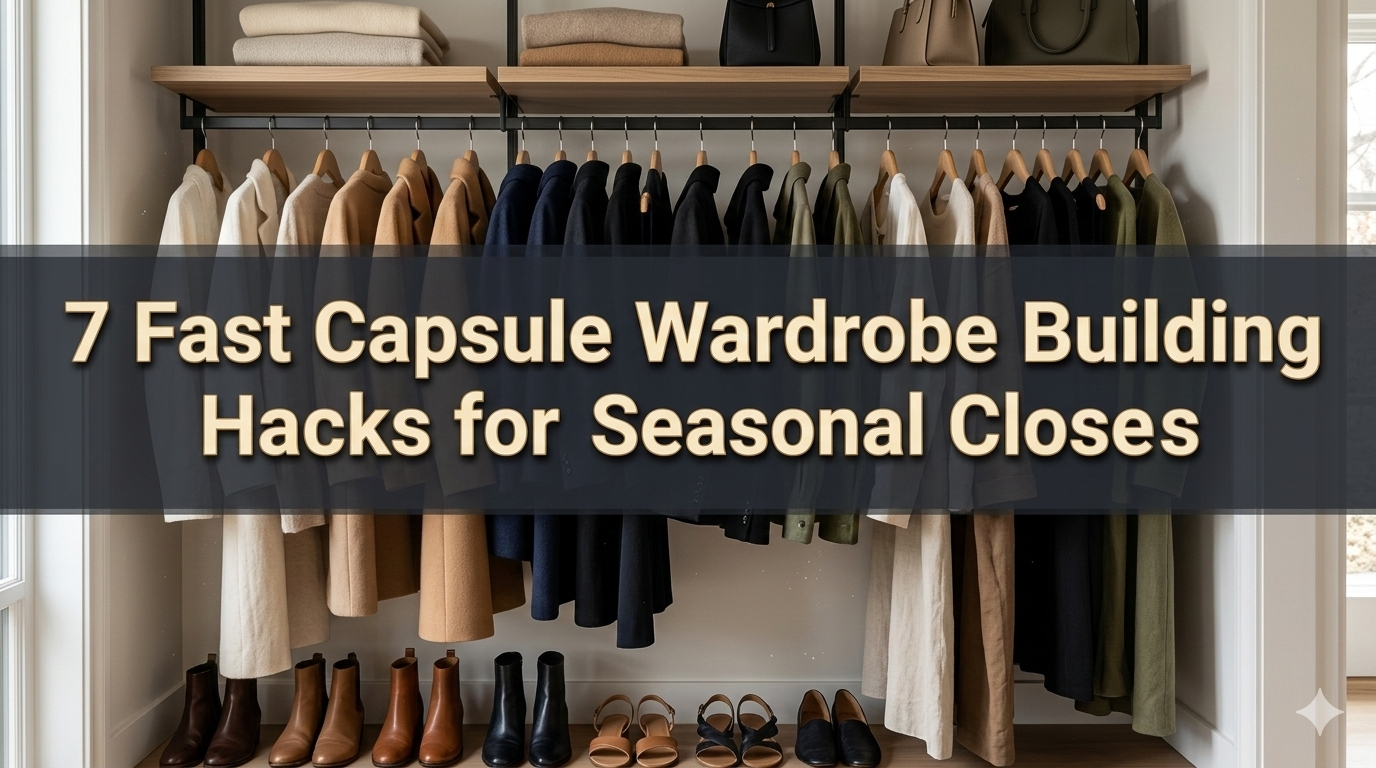

Your Wardrobe Shouldn’t Change as Much as the Weather
Spring comes. You dig out your light jackets. Summer hits. You swap to shorts and tees. Autumn descends. Time for layers and boots again. Winter arrives. Suddenly you need everything heavier.
And in all that flipping, your closet becomes a disaster zone.
Most people think of each season as a totally different wardrobe. They pack some things away, hang others back up, purchase new seasonal items, and wind up with four mini-wardrobes shoved into one space. It is draining, costly, and altogether avoidable.
Building a capsule wardrobe for all seasons is a different approach entirely.
Rather than battling the season, you assemble a smart wardrobe that works with it. You layer, you make smart choices about fabric and color, and you maintain a consistent color strategy that allows most of your wardrobe to function year-round. Then you sprinkle in a small handful of season-specific pieces only when truly needed.
The result? Less clutter. Fewer purchases. More outfits. And getting dressed — in any season — becomes genuinely easy.
Here are 6 tried-and-true capsule wardrobe building tricks designed specifically for those of us who live somewhere the weather actually changes. This is practical, budget-friendly advice for real life — not Instagram-friendly flat lays.
Trick #1 — Create One Core Wardrobe and Layer from It Each Season
Forget four distinct seasonal wardrobes. Think instead: one core wardrobe + seasonal layers.
Your core wardrobe is the foundation on which everything else sits — a collection of pieces you wear all year round, just styled differently.
What Makes Up Your Year-Round Core
These are pieces that genuinely work across all four seasons with the right styling:
Core Tops:
- Classic tees in neutral shades (worn alone in summer, layered under sweaters in winter)
- Fitted long-sleeve shirts (layered under jackets or worn alone in spring/fall)
- Basic button-down shirts (light enough for summer, layer-able for winter)
Core Bottoms:
- Dark straight-leg jeans (worn year-round with different footwear and layers)
- Chinos or tailored trousers (office or casual in every season)
- A relaxed short or skirt for warm-weather transitions
Core Layers:
- A tailored blazer (over t-shirts in autumn, over short-sleeve button-ups in spring, over sweaters in winter)
- A classic denim jacket (ideal mid-layer for spring, fall, and breezy summer evenings)
- A versatile cardigan (works over everything in every season)
The Layer Stack System
Think of your all-season outfits as stacks:
- Winter stack: Tee → Turtleneck/Sweater → Blazer or Coat
- Fall/Spring stack: Tee or Long-Sleeve → Light jacket or cardigan
- Summer stack: Tee or Button-Down → That’s it (or one light layer for air conditioning)
This way, one item creates outfits across all four seasons. A single white button-down becomes a summer shirt, a fall blazer base, a winter chunky-sweater filler, and a spring transitional top over light trousers.
That’s capsule wardrobe building at its most efficient.
Trick #2 — Choose Fabrics That Work Across Multiple Seasons
Here’s something most style guides completely leave out: the fabric of your clothes matters more than their style when it comes to all-season dressing.
You can curate an aesthetically flawless capsule wardrobe. But if your pieces are made of the wrong materials, they’ll only function in one climate — and you’re right back to square one.
The All-Season Fabric Hit List
| Fabric | Best Seasons | Why It Works |
|---|---|---|
| Cotton (medium weight) | Spring, Summer, Fall | Breathes well, layerable, easy to wash |
| Merino Wool | Fall, Winter, Spring | Regulates temperature, non-itchy, feels light |
| Chambray | Spring, Summer, Fall | Looks like denim but breathes like cotton |
| Linen (heavier weave) | Spring, Summer | Light and breathable; wrinkles are character |
| Ponte knit | Fall, Winter, Spring | Structured, warm enough, holds shape |
| Tencel/Lyocell | All seasons | Soft, supple, and drapey |
Fabrics to Avoid in a Year-Round Capsule
- Heavy 100% wool — only wearable in cold weather
- Polyester fleece — great for winter, useless in summer
- Thin, flimsy polyester blends — too cold in winter, sweaty in summer
- Heavy canvas or rigid outerwear denim — difficult to layer in deep cold
The Weight Rule
Within the same fabric category, weight makes all the difference.
A lightweight merino tee works in late spring and early fall. A medium-weight merino sweater carries you through fall and winter. A heavyweight merino turtleneck is midwinter territory.
When shopping, check labels. For knitwear, look for descriptors like “lightweight,” “mid-weight,” or specific GSM numbers.
This one small habit will make your capsule dramatically more versatile across every season.
Trick #3 — Anchor a Palette That Translates Smoothly Across Seasons
Color is one of the most powerful tools in capsule wardrobe building — and one of the most misused.
Some people choose a color palette based on what’s trending that year, only to find that their “summer colors” feel off in November and their “winter palette” looks too heavy in April.
The solution is a seasonally neutral color palette — one that feels appropriate in any month without looking out of place.
The Year-Round Color Framework
Anchor Neutrals (wear across all seasons — the backbone of your all-season capsule): Black, white, navy, grey, camel, cream, tan
These work in every month of the year. A navy blazer is right at home in February and July alike. A cream turtleneck carries you from early fall through late winter without missing a beat.
Soft Accent Colors (multi-seasonal — bring personality without committing to one season): Olive, terracotta, dusty rose, slate blue, burgundy, warm brown
These tones cross seasons naturally. Olive works in spring, summer, fall, and winter. Terracotta shines from late summer through autumn. Burgundy earns its place from September through March.
Seasonal Accent Colors (a little goes a long way — acknowledge the season without letting it take over):
- Vibrant coral or cobalt blue (summer)
- Rich forest green or burnt orange (fall)
- Ice blue or bright red (winter)
- Lilac or soft yellow (spring)
All-Season Color Palette Breakdown
| Palette Layer | Share | Lifespan |
|---|---|---|
| Anchor Neutrals | ~55% | Every single month |
| Soft Accents | ~35% | 6–9 months of the year |
| Seasonal Pops | ~10% | Rotate every 3 months |
When everything in your closet falls within this kind of palette, any top can mix with any bottom — add any layer and it works, no matter what month it is.
Trick #4 — Master the Transitional Outfit Formula
The in-between moments are always the hardest weeks of the dressing year.
Late September, when mornings are chilly but afternoons hit 72 degrees. Early April, when it’s warmish but could still snow. Early November, when fall has officially ended but full winter gear feels like too much.
These transitional weeks can derail most capsule wardrobes — or make a smart one shine.
The 3-Piece Transitional Formula
Good transitional outfits follow a reliable framework:
Base Layer + Mid Layer + Versatile Outer Layer
Here’s what that looks like in practice:
| Transition | Base | Mid | Outer |
|---|---|---|---|
| Summer → Fall | Light tee | — | Denim jacket or light blazer |
| Fall → Winter | Long-sleeve tee | Sweater or flannel | Trench coat or wool coat |
| Winter → Spring | Fitted tee | Light knit cardigan | Unlined trench or jacket |
| Spring → Summer | Button-down | — | Light scarf or open overshirt |
The Removable Layer Test
Here’s a practical tip that doesn’t get mentioned nearly enough:
Your outfit has to work with and without the outer layer.
On an unpredictable weather day, ask yourself before leaving the house: “If I remove this outer layer at 2pm, will I still look put-together?”
If yes — great outfit. If no — swap or add a piece before you go.
That one simple mental check is all it takes to make your capsule work through the messiest seasonal transitions of the year.
Footwear for Transitional Seasons
Shoes are often the one detail that signals an outfit is out of sync with the season.
Footwear that genuinely straddles multiple seasons:
- Suede or leather loafers (spring, fall, mild winter)
- Leather sneakers (spring, summer, early fall)
- Ankle boots (fall, winter, early spring)
- Chelsea boots with minimal soles (fall through early spring)
Two or three of these footwear anchors in your capsule handle most seasonal transitions without needing a dedicated shoe collection for every season.
Trick #5 — Build Seasonal Add-Ons, Not an Entire Seasonal Wardrobe
No matter how well-built your all-season capsule is, it will always need a few seasonal pieces.
But here’s the key word: few.
Most people go overboard. They pick up ten new summer pieces and twelve new winter things, and suddenly their capsule has exploded. The solution is to set a firm limit on how many season-specific pieces you allow yourself.
The Season Add-On Rule: 7 Pieces Maximum
For each season, give yourself 5–7 season-specific add-ons to complement your year-round core.
Summer Add-Ons (limit 7 pieces):
- 1–2 light linen or cotton dresses or shorts
- 1 casual sandal or espadrille
- 1 lightweight sun hat or cap
- 1 swimwear set (if needed)
- 1 lightweight layer for air-conditioned spaces (thin kimono or cotton overshirt)
Winter Add-Ons (limit 7 pieces):
- 1 heavy wool or puffer coat
- 1 chunky knit sweater or turtleneck
- 1 pair of weatherproof boots
- 1 warm scarf
- 1 set of thermal base layers (these can be discreet)
- 1 beanie or cold-weather hat
Fall/Spring Add-Ons (up to 5 pieces): (These bridging seasons overlap heavily with your core, so fewer add-ons are needed.)
- 1 mid-weight transitional jacket (bomber, quilted, or field jacket)
- 1 pair of ankle boots or weather-resistant sneakers
- 1 lightweight scarf
Smart Add-Ons vs. Full Seasonal Wardrobes
| System | Annual New Purchases | Total Wardrobe Size | Trajectory |
|---|---|---|---|
| Full seasonal wardrobe | 15–25 pieces | 60–100 pieces | Grows constantly |
| Smart add-on system | 5–7 pieces | 20–28 pieces | Stays controlled |
| Capsule only (no seasonal) | 0–5 pieces | Very small | Very minimal |
The smart add-on system combines the best of both worlds. Your closet feels appropriately seasonal without descending into chaos.
Trick #6 — Do a Seasonal Reset Instead of a Full Wardrobe Overhaul
This is where most people waste the most time and energy.
They drag storage bins up from the basement each season, try on everything, and rearrange their entire closet as if it’s a major project. Then six months later, they do it all over again.
The seasonal reset method is quicker, smarter, and keeps your capsule in great shape year-round — without the biannual wardrobe avalanche.
How a Seasonal Reset Actually Works
A seasonal reset takes 45–60 minutes, not a whole weekend. Here’s the process:
Step 1: Rotate (10 minutes) Move off-season items to a bin or secondary storage. Bring next-season pieces into your active closet. You’re not auditing yet — just swapping.
Step 2: Quick Wear-Test (20 minutes) Before anything returns to active rotation, try it on if you haven’t worn it in the past season. Check for fit, condition, and whether you still actually like it.
Step 3: Edit and Note Gaps (15 minutes) Anything that barely passed the wear-test goes — donate, sell, or discard. If you notice a genuine gap (maybe last winter you kept wishing for a better mid-layer), write it down. That becomes your one deliberate shopping task for the new season.
Step 4: Rethink Your Layout (10 minutes) Rearrange what’s left so everything is visible. Keep your most-reached-for pieces at the front. Move newer or less-used pieces toward the back.
The One Shopping List Rule
Each season, you’re allowed one specific shopping list — not a vague browse to “see what jumps out.” A specific list, based only on the gaps you identified in Step 3. Those are your only purchases for that season.
This one habit alone will cut your clothing spend significantly within a year. For more help planning a streamlined, intentional wardrobe, Minimal Wardrobe Plan is a great resource to bookmark.
Seasonal Reset Calendar
| Month | Action |
|---|---|
| March | Spring reset — rotate in light layers and transition pieces |
| June | Summer reset — add warm-weather items |
| September | Fall reset — heaviest transition, most gear to swap |
| December | Winter reset — full cold-weather mode, check coat and boot condition |
Block one hour in your calendar for each of these. That’s just four hours over the entire year to keep your capsule running smoothly through every season.
Building Your All-Season Capsule: A Practical Starting Point
Here’s one example of a 40-piece all-season capsule that covers a casual to smart-casual lifestyle across all four seasons:
Year-Round Core (27 pieces)
Tops (10): 3 neutral tees, 2 fitted long-sleeve shirts, 2 button-downs (1 light, 1 chambray), 1 merino turtleneck, 1 simple knit sweater, 1 lightweight hoodie
Bottoms (6): 2 dark jeans, 1 light-wash jean, 1 black tailored trouser, 1 chino, 1 casual short or skirt
Layers (5): 1 blazer, 1 denim jacket, 1 cardigan, 1 trench coat, 1 leather or faux-leather jacket
Shoes (4): White sneakers, loafers, ankle boots, 1 dressier option
Accessories (2): Belt, versatile tote bag
Season-Specific Add-Ons (13 pieces)
Summer (4): 1 linen shirt, 1 casual dress or shorts, 1 sandal, 1 cap
Winter (5): 1 wool coat, 1 chunky knit, 1 weatherproof boot, 1 warm scarf, 1 beanie
Fall/Spring (4): 1 field jacket, 1 ankle boot (second pair), 1 light scarf, 1 transitional mid-layer
Total: 40 pieces. Fully functional in every season.
Common Questions on All-Season Capsule Wardrobe Building
Q: What is an all-season capsule, and how is it different from a standard capsule wardrobe? A classic capsule wardrobe is built around a broad lifestyle. An all-season capsule is specifically designed so that core pieces work across different weather through layering, fabric selection, and a neutral color palette — rather than replacing entire sections of clothing every few months.
Q: Do I have to live somewhere with four distinct seasons to benefit from this approach? Not at all. The layering system and fabric-first approach suit even milder climates. An all-season capsule is actually even more useful if you travel frequently between varying climates.
Q: How do I handle work clothes in an all-season capsule wardrobe? The same principles apply. Invest in tailored trousers, a blazer, and button-downs in seasonally neutral shades. Layer for warmth when needed. A trench coat often doubles as office-appropriate outerwear across almost any season.
Q: What’s the biggest mistake people make when building a seasonal capsule? Over-buying for each season. It’s easy to treat a new season as an excuse to shop heavily. The secret is to use each seasonal update as a minimal tweak, not a shopping spree. Stick to your 5–7 add-ons, and only fill real gaps.
Q: Is merino wool worth the extra cost for a capsule wardrobe? For an all-season capsule in particular — yes. Merino wool regulates temperature better than most synthetics, resists odor, and with proper care can last for years. A solid merino sweater or base layer is one of the best value investments you can make for a four-season capsule. Gear Junkie has a helpful breakdown of what to look for when buying merino.
Q: Can I build an all-season capsule wardrobe on a budget? Absolutely. Start with what you already own and identify your foundational pieces. Thrift stores and secondhand apps are excellent sources for quality basics at low prices. Spend your new-purchase budget on only 1–2 gap-filling pieces per season. You don’t have to buy everything at once.
The Every-Season Wardrobe You’ve Been Trying to Build
Most people have attempted to simplify their closet at some point. They cleared some things out, picked up a few “key basics,” and then slowly watched it fill back up with random pieces that don’t connect.
That cycle stops when you approach capsule wardrobe building as a system — not a one-time event.
The six tricks in this guide are interdependent. You start with a strong core that builds naturally over time. You choose fabrics that perform in real weather. You commit to one color palette that doesn’t shift with the calendar. You master transitional dressing so you’re never caught off guard. You keep seasonal add-ons minimal so they don’t disrupt your wardrobe. And you do quick seasonal resets instead of dreading a full overhaul twice a year.
None of this requires a large budget or a design background. It just requires a plan.
Pick one trick to try this week. If it all feels overwhelming, start with a closet audit and identify your core pieces. Layer in the other strategies as you go.
Your closet will be ready for the next season when it arrives — without the frenzy.

Related Posts