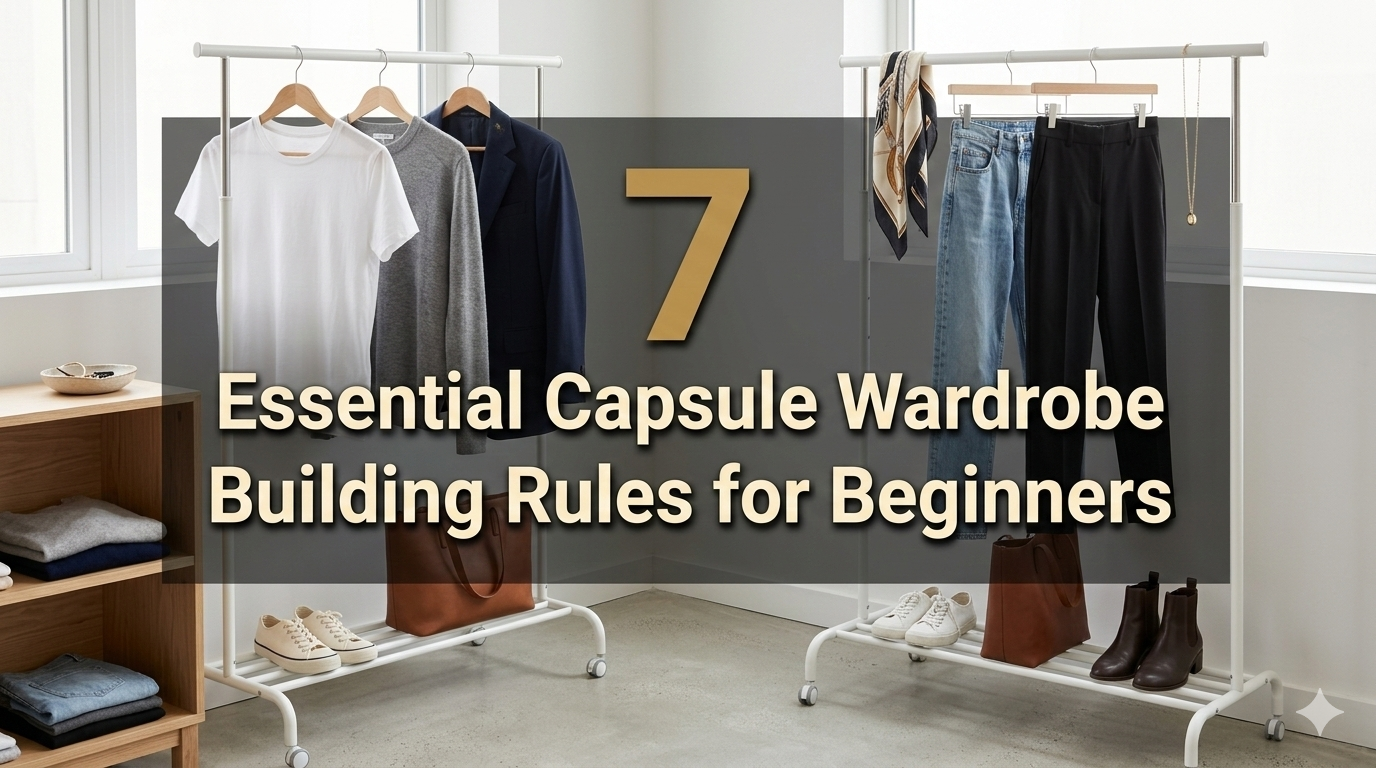
TCapsule Wardrobe Building Rules for Beginners: 7 Must-Know Tips
Here’s one that most people have been through — looking at a closet full of clothes and proclaiming, “I have nothing to wear.”
It sounds funny. But it’s a real problem. Too many choices, too little coordination, no clarity.
And that’s precisely where a capsule wardrobe really kicks in.
A capsule wardrobe is a small, curated group of clothing that all complement each other. Every piece earns its place. All outfits come together without a sweat. And getting dressed in the morning? It turns into the easiest part of your day.
If this concept is new to you, you are in the right place. We’re sharing the 7 must-know capsule wardrobe building rules for beginners in this guide — written simply, clearly and practically.
Let’s get into it.
What Is a Capsule Wardrobe, Exactly?
Before we jump into the rules, a quick refresher to ensure we are all on the same page.
Most capsule wardrobes consist of between 25 to 50 pieces of clothing. These items are picked so that they can easily mix and match with each other. The goal isn’t having fewer clothes for minimalism’s sake. The goal is to have the right amount of clothes — the ones that fit well, reflect your style and meet your needs on a day-to-day basis.
The idea originated with London boutique owner Susie Faux in the 1970s. She called it a wardrobe of must-haves that would never go out of style. Donna Karan then popularized it in America with her iconic “Seven Easy Pieces” collection in 1985.
Today, capsule wardrobes are hugely popular — and for good reason.
| Traditional Closet | Capsule Wardrobe |
|---|---|
| 100+ items, many never worn | 25–50 selected pieces |
| Difficult to mix and match | Everything coordinates |
| Getting dressed takes longer | Outfits come together quickly |
| Cluttered and overwhelming | Clean, organized, stress-free |
| Frequent impulse buying | Intentional, purposeful shopping |
Why Building a Capsule Wardrobe Is Well Worth Your Time
Others read “fewer clothes” and shudder at the prospect of boredom.
It’s the opposite, actually.
With a purpose-built wardrobe, everything you own has a place in your life. You stop spending money on things you’ll never wear. You cease being overwhelmed with choices. And then you begin to feel more confident, because every outfit actually works.
There is real research showing that decision fatigue — mental exhaustion from too many choices — exists. A capsule wardrobe slashes that fatigue. Instead, you make better choices more quickly with less stress.
And here are the 7 rules that make all of this happen.
Rule 1 — Declutter Before You Shop
The biggest mistake most beginners make is this: they assume creating a capsule wardrobe means shopping for new things to begin with.
It doesn’t.
It begins with an honest look at what you already have.
Do a Full Closet Audit
Pull everything out. Yes, everything. Spread it out on your bed, on your floor, wherever you’ve got some room.
Take each item and ask three questions about it:
- Does this fit me well right now?
- Have I worn this in the past 12 months?
- Do I feel good when I wear it?
If the answer to any of these three is no, it’s a candidate for removal.
You’re probably going to see items fall into a few categories:
- Keep: Good fit, worn often, makes you feel good
- Maybe: Needs changes, or you’re not sure — put on hold
- Get Rid Of: Doesn’t fit, hasn’t been worn, or you just don’t like it anymore
Be honest. This step isn’t just about throwing away things you don’t use. It’s about clarifying what really serves you.
The “Maybe” Pile Strategy
Pack all of your “maybe” items in a box and seal it. Write today’s date on it. If you haven’t opened the box in 3 months to retrieve anything specific, donate or sell the contents.
This technique avoids guilt and hesitation. It also tells you, in real time, what you actually miss versus what you thought was essential.
Rule 2 — Know Your True Lifestyle Before Selecting Pieces
Here’s the mistake many beginners make: they build their capsule wardrobe for the life they want, not the life they have.
They pack it with blazers and heels while working from home in joggers every day. Or they stock up on smart-looking tees while having a corporate job five days out of the week.
Your closet needs to reflect your actual, real life.
Map Out Your Weekly Routine
Think about a typical week. How do you roughly divide your days between each?
| Life Category | Possible Activities | Wardrobe Requirements |
|---|---|---|
| Work/professional | Meetings, client calls | Polished, smart pieces |
| Casual/everyday | Errands, at home, coffee with friends | Comfortable basics |
| Active/fitness | Gym and fitness classes | Performance wear |
| Social/events | Dinners, parties, dates | Elevated or stylish pieces |
A rough percentage breakdown is helpful here. If 70 percent of your week is casual, your closet should mirror that — roughly 70 percent casual pieces, 20 percent workwear, 10 percent for special occasions.
This is your own wardrobe ratio, and it varies from person to person.
Don’t Build for the Façade of Your Life
It’s too easy to throw in that cocktail dress “just in case.” But if you attend one formal function a year, you don’t need three formal pieces in your capsule. A single well-chosen piece — or a rental strategy for rare occasions — is much smarter.
Rule 3 — Build Your Base in Neutral Colors
Color is where many beginners go astray.
They have clothes in 15 different colors, and nothing goes with anything. The result? Chaos.
In a capsule wardrobe, everything goes with everything. And it all starts from a strong neutral base.
The Power of Neutrals
Neutrals are colors that pair well with nearly everything. The most common include:
- Black — timeless, slimming, goes with just about any color
- White/Off-white — crisp, clean, works every season
- Navy — a softer alternative to black, super versatile
- Gray — suits both warm and cool undertones equally
- Camel/Tan — warm, earthy tones that are great for layering
- Cream/Beige — soft and sophisticated, perfect for a refined palette
Neutral-colored pieces should make up about 70–80% of your capsule wardrobe.
Adding Accent Colors
The rest — 20–30% of your palette — can be your accent colors: the hues that reflect your personality or add interest to outfits.
How to choose your accent colors:
- Select 1–2 colors that you enjoy wearing
- Ensure they work alongside your neutral base
- Test that they pair with at least 3 other items you already own
A sample color palette for a capsule wardrobe:
| Base Neutrals (70–80%) | Accent Colors (20–30%) |
|---|---|
| White · Navy · Camel · Grey | Rust · Olive |
That kind of palette renders nearly any top compatible with most pairs of pants. Outfits build themselves.
Rule 4 — Prioritize Fit Above Everything Else
This is the rule that differentiates good wardrobes from great ones.
Fit matters more than brand. It matters more than price. It matters more than style.
A well-fitting $30 shirt will always look better than a poorly fitting $200 one.
What “Good Fit” Actually Means
What constitutes a good fit varies by garment type, but here are the key checkpoints:
For tops and shirts:
- Shoulder seams fall on the edge of your shoulder
- No pulling across the chest or back
- Sleeves reach the right point on your wrist
For trousers and jeans:
- No gaps at the waistband
- No bunching at the crotch
- Hem falls at the right length for your height
For jackets and blazers:
- Shoulder seams aligned properly
- Lapels lay flat
- Sleeves reveal a bit of shirt cuff
Alterations Are Not Cheating
A tailor is one of the most overlooked tools when it comes to creating a capsule wardrobe.
If a pair of pants fits everywhere but the length — have them hemmed. If a blouse is almost right but slightly too big in the waist — have it taken in.
Even minor alterations can be quite affordable. And they can turn a good piece into a perfect one.
Rule 5 — Always Choose Quality Over Quantity
A capsule wardrobe is built on fewer, better things. That means shifting your mindset from “how much can I get?” to “how good is this piece?”
The Cost-Per-Wear Formula
The best way to think about clothing quality is the cost-per-wear formula:
Cost-Per-Wear = Total Price ÷ Number of Times You’ll Wear It
A $150 coat you wear 200 times over 5 years costs $0.75 per wear. A $30 fast-fashion shirt you wear 3 times before it falls apart costs $10 per wear.
Which is actually more expensive?
| Item | Price | Times Worn | Cost Per Wear |
|---|---|---|---|
| Quality wool coat | $180 | 180 | $1.00 |
| Fast-fashion jacket | $40 | 8 | $5.00 |
| Classic white shirt | $90 | 120 | $0.75 |
| Trendy graphic tee | $20 | 5 | $4.00 |
The numbers tell a clear story.
What to Check When Shopping for Quality Clothing
You don’t have to be a fashion expert to spot quality. Here are some simple things to look for:
- Fabric weight: Hold it up — does it feel substantial or flimsy?
- Stitching: Look at the seams. Are stitches even and tight?
- Buttons and zippers: Do they feel sturdy, or are they flimsy?
- Lining: Is it lined where needed, and does it hang flat?
- Care label: Natural materials like cotton, linen and wool generally last longer than synthetic blends
You don’t have to spend a lot. You simply have to spend intentionally.
Rule 6 — Master the Art of Layering
An early fear for beginners: “Won’t I get bored wearing the same pieces again and again?”
Not if you know how to layer.
Layering is the art of wearing pieces together to create new outfits without buying anything new. It’s what turns a 30-piece capsule wardrobe into 100 outfit options.
The 3-Layer Formula
Most outfits follow a simple three-layer structure:
- Base layer — The layer closest to your body (a t-shirt, tank, or fitted long-sleeve)
- Middle layer — An extra layer for warmth and/or structure (shirt, sweater, cardigan)
- Outer layer — The finishing piece (coat, jacket, blazer, or trench)
You won’t always need all three. But knowing the structure allows you to mix pieces intentionally.
Layering Examples Using Simple Capsule Pieces
- Casual: White t-shirt + oversized denim jacket + white sneakers
- Smart casual: Fitted turtleneck + camel trench coat + ankle trousers + pumps
- Work-appropriate: White button-down shirt + navy blazer + tailored pants + leather flats
The same trench coat, the same blazer, the same turtleneck — only rearranged. Three completely different looks.
Proportion Play
Layering also involves proportion. Pair a loose, oversized top with narrow-fit trousers. Tuck in a fitted shirt to highlight the waist. Allow a longer cardigan to drape open over a fitted dress.
Adjusting proportions makes outfits visually exciting — without adding more clothes.
Rule 7 — Treat Your Capsule Wardrobe as a Living System
The biggest mistake people make after creating a capsule wardrobe is treating it as “finished.”
It’s not finished. It evolves.
Your life changes. Seasons change. Your style evolves. And so should your capsule wardrobe.
The Seasonal Review Method
Twice a year — during the transition from spring/summer to fall/winter and back again — conduct a mini audit.
Ask yourself:
- What did I reach for most this past season?
- What sat untouched?
- What is worn out and needs replacing?
- Do I have a gap that has had me buying duplicates?
This check-in keeps your closet intentional and ensures it doesn’t quietly refill with pieces that don’t serve you.
The One-In, One-Out Rule
When you add a new item to your capsule, remove an old one.
This stops closet creep — the slow, sneaky process of a wardrobe growing back to an overwhelming size.
Bought a fresh pair of white jeans? The old worn-out pair leaves. New navy blazer? The old one that no longer fits goes to donation.
It keeps the balance. It keeps the system working.
Shopping Intentionally Going Forward
When you do shop for your capsule, do so with a list. Know what gap you’re filling before walking into a store or opening a website.
Ask these questions before buying anything:
- Does this work with at least 3 other items already in my closet?
- Is this filling a genuine gap, or is it an impulse?
- Will I still want this 2 years from now?
- Does it fit right now — not “when I lose weight” or “when I find the right shoes”?
Intentional shopping is a skill. It gets easier the more you do it. For more structured guidance on building and maintaining a mindful wardrobe, Minimal Wardrobe Plan is a great place to start.
Your Starter Capsule Wardrobe Checklist
These are foundational pieces that work across most lifestyles. Adjust based on your personal style and routine.
Tops
- 3 plain t-shirts (white, grey, black or navy)
- 2 button-downs (white and one neutral)
- 1–2 lightweight knits or blouses
- 1 fitted turtleneck or long-sleeve top
- 1 casual sweater or crewneck
Bottoms
- 2 pairs of jeans (1 dark, 1 medium wash)
- 1–2 tailored trousers (black or navy)
- 1 versatile skirt or shorts depending on your climate
Layers and Outerwear
- 1 denim jacket
- 1 blazer (structured, black or navy)
- 1 cardigan or oversized knit
- 1 quality coat or trench coat
Footwear
- 1 pair white or neutral sneakers
- 1 pair flat leather or faux-leather shoes (loafers, flats or ankle boots)
- 1 pair simple sandals (if relevant to your climate)
Accessories (Optional but Powerful)
- A simple belt
- 1–2 scarves or bandanas
- Minimal jewelry basics
This comes out to approximately 25–35 items — a solid, functional capsule for any newcomer.
Common Capsule Wardrobe Mistakes to Avoid
Beginners often trip up in the following areas, even with the best intentions:
| Mistake | Why It Happens | How to Fix It |
|---|---|---|
| Keeping things “just in case” | Fear of letting go | Use the sealed box method |
| Buying too many trendy pieces | Impulse shopping | Use 80% classics / 20% trends |
| Ignoring fit issues | Planning to “fix it later” | Get it altered or get rid of it immediately |
| Not accounting for your real lifestyle | Wishful thinking | Map your actual week |
| Rebuilding too soon | Impatience | Add one piece at a time, with intention |
FAQs About Capsule Wardrobe Building
Q: How many items should a beginner’s capsule wardrobe have? Start with 25–35 pieces. That gives you a decent variety without being too much. Once you learn what works best for your lifestyle, you can always adjust up or down.
Q: Does a capsule wardrobe have to be expensive? No. It is still possible to create a great capsule wardrobe on a budget. Start by shopping your existing closet, then fill in gaps one piece at a time — thrift stores, secondhand apps and affordable quality brands are all great options. The Good On You brand directory is a useful resource for finding ethical, budget-conscious labels.
Q: Can a capsule wardrobe work for every season? Yes. Most people maintain a year-round core capsule and swap in a small number of seasonal pieces (heavy coats, linen shirts) as the weather changes. It keeps things manageable without compromising function.
Q: What if I work in an office with a dress code? Your capsule wardrobe should reflect your actual life — and if your job has a dress code, that’s a significant part of it. Dedicate a portion of your capsule to work-appropriate pieces that still coordinate with the rest of your wardrobe.
Q: How long does it take to build a proper capsule wardrobe? Most people take 3–6 months. This allows you to identify real gaps, shop with purpose and experiment with what truly works. Take your time.
Q: What about laundry — won’t I quickly run out of clothes? This is a valid concern. The key is having enough of your most-used basics (t-shirts, underwear) to comfortably get through a full laundry cycle. Most people find that a well-constructed capsule meshes nicely with a regular laundry rhythm.
Q: Is a capsule wardrobe just for women? Absolutely not. Capsule wardrobes work for any and all genders. The principles — neutrals, good fit, quality, intentionality — are universal. The specific pieces simply depend on personal style and lifestyle needs.
Wrapping It All Up
Building a capsule wardrobe is not about owning the fewest number of garments. It is about having the right clothes — pieces that fit your body, your life and your aesthetic.
The 7 rules in this guide give you a clear way forward:
- Start with a closet clear-out
- Understand your true lifestyle before selecting pieces
- Build from a neutral color foundation
- Prioritize fit above everything else
- Choose quality over quantity
- Master the art of layering
- Treat your wardrobe as a dynamic, living system
Follow these rules, and getting dressed is no longer a chore. It becomes something you genuinely enjoy.
Start small. Start honest. Start with what you have.
Your capsule wardrobe isn’t as far away as you think.

Related Posts