
A capsule wardrobe sounds simple on paper: fewer clothes, better outfits, less stress. But in practice, most people either overcomplicate it or strip it down so much that getting dressed becomes harder, not easier. The real advantage of a capsule wardrobe isn’t just minimalism—it’s speed, clarity, and consistency.
This article walks through five practical, field-tested hacks that make a capsule wardrobe actually save time every single day. You’ll find not just ideas, but structures, tables, and visual-style breakdowns that help you apply each concept without guesswork.
hack 1: build a “uniform core” instead of a full capsule
Most capsule wardrobe guides push you toward variety within limits. That sounds good, but it often leads to decision fatigue. The smarter approach is to build a “uniform core”—a small set of repeatable outfit formulas you can rely on without thinking.
Think of it this way: instead of asking “what should I wear today?”, you ask “which version of my uniform fits today?”
A uniform core is not about wearing the exact same outfit daily. It’s about defining 2–3 silhouettes or combinations that always work for you.
Example of a uniform core system:
| Uniform Type | Top Options | Bottom Options | Layer Options | Shoes Options |
|---|---|---|---|---|
| Casual Everyday | White tee, grey tee | Dark jeans, chinos | Denim jacket | Sneakers |
| Smart Casual | Button-down shirt | Black trousers | Blazer | Loafers |
| Relaxed Weekend | Oversized tee | Joggers | Hoodie | Slip-ons |
How this saves time:
- You eliminate 80% of decisions
- You only choose within a fixed structure
- You never build outfits from scratch
Micro-decision reduction chart:
| Step | Traditional Wardrobe | Uniform Core System |
|---|---|---|
| Choose top | 20+ options | 3–5 options |
| Choose bottom | 15+ options | 2–3 options |
| Match outfit | High effort | Automatic |
| Total time (daily) | 5–10 minutes | 1–2 minutes |
The key insight: repetition is not boring—it’s efficient. People don’t notice repetition as much as you think, but they do notice consistency.
hack 2: use the “color grid rule” for instant matching
Color coordination is one of the biggest time drains when dressing. A capsule wardrobe becomes powerful only when everything works together without effort.
The color grid rule simplifies this completely.
You define:
- 2 base colors (e.g., black, navy)
- 2 neutral colors (e.g., white, grey)
- 1 accent color (e.g., olive, burgundy)
Then every item must fit within this system.
Example color grid:
| Category | Color Choices |
|---|---|
| Base Colors | Black, Navy |
| Neutrals | White, Grey |
| Accent | Olive |
Compatibility matrix:
| Item Color | Works With |
|---|---|
| Black | All colors |
| Navy | White, Grey, Olive |
| White | All colors |
| Grey | Black, Navy, Olive |
| Olive | Black, White, Grey |
What this means:
- Any top works with any bottom
- Any layer fits any base outfit
- No mismatching stress
Time impact visualization:
| Scenario | Without Color System | With Color Grid |
|---|---|---|
| Outfit matching attempts | 3–5 tries | 1 try |
| Mirror adjustments | Frequent | Rare |
| Daily outfit certainty | Low | High |
A useful trick: lay out your wardrobe visually in rows (tops, bottoms, layers). If you can draw lines between most items mentally, your system works. If not, remove or replace the outliers.
hack 3: pre-build “outfit packs” for the week
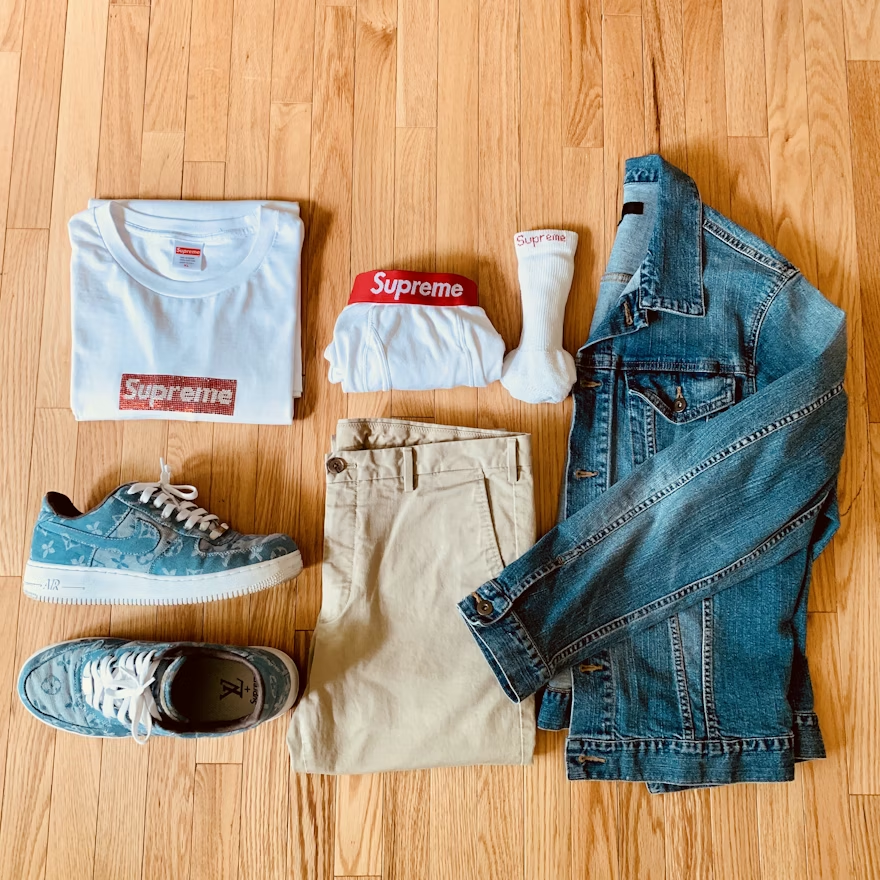
Even with a good capsule, daily decisions can creep back in. The fastest dressers don’t decide daily—they decide once per week.
That’s where outfit packs come in.
An outfit pack is a fully assembled outfit (top + bottom + shoes + optional layer) planned ahead of time.
Weekly outfit pack example:
| Day | Outfit Description |
|---|---|
| Monday | White tee + black jeans + sneakers |
| Tuesday | Blue shirt + navy trousers + loafers |
| Wednesday | Grey tee + chinos + denim jacket |
| Thursday | White shirt + black trousers + blazer |
| Friday | Oversized tee + joggers + slip-ons |
Why this works:
- You eliminate morning decision-making
- You avoid decision fatigue entirely
- You create rhythm in your wardrobe
Time-saving breakdown:
| Task | Daily Planning | Weekly Packs |
|---|---|---|
| Outfit decision | 5 min/day | 20 min/week |
| Weekly total | 35 min | 20 min |
| Mental effort | High daily | One-time |
Extra benefit: outfit packs help you spot gaps in your wardrobe. If you struggle to build five solid outfits, you don’t need more clothes—you need better-aligned pieces.
hack 4: adopt the “one-in, one-out” rule with tracking
A capsule wardrobe fails when it slowly grows out of control. The “one-in, one-out” rule keeps it tight, but tracking makes it powerful.
The rule:
Whenever you add a new item, one item must leave.
But here’s the upgrade—track usage frequency.
Wardrobe usage tracker example:
| Item | Worn Per Week | Last Worn | Keep/Remove Decision |
|---|---|---|---|
| White T-shirt | 3 | 2 days ago | Keep |
| Black jeans | 2 | 4 days ago | Keep |
| Blue shirt | 0 | 3 weeks ago | Remove |
| Grey hoodie | 1 | 1 week ago | Keep |
What this reveals:
- You see what actually saves time (frequent items)
- You eliminate rarely-used distractions
- Your wardrobe becomes more efficient over time
Efficiency chart:
| Wardrobe Size | Active Items (%) | Decision Speed |
|---|---|---|
| 50 items | 40% | Slow |
| 30 items | 70% | Medium |
| 20 items | 90% | Fast |
The goal is not fewer clothes—it’s higher usage density.
hack 5: organize by “grab zones” instead of categories
Traditional wardrobes are organized by type: shirts, pants, jackets. That’s logical, but not efficient.
A faster system is organizing by “grab zones”—grouping items based on how you use them together.
Example layout:
| Zone Name | Contents |
|---|---|
| Daily Essentials | Most-used tees, jeans, sneakers |
| Workwear | Shirts, trousers, blazers |
| Relaxed Wear | Hoodies, joggers, casual tees |
| Outerwear Zone | Jackets, coats |
Instead of searching across your wardrobe, you go directly to the zone that matches your day.
Time comparison:
| Action | Category System | Grab Zone System |
|---|---|---|
| Find matching outfit pieces | Multiple areas | Single area |
| Time spent searching | 2–4 minutes | <1 minute |
| Cognitive effort | Medium | Low |
Bonus tip: place your “daily essentials” zone at eye level. Accessibility directly impacts speed.
integrated system: how all 5 hacks work together
Each hack works individually, but the real power comes from combining them.
System flow:
- Define uniform core (structure)
- Apply color grid (compatibility)
- Build outfit packs (planning)
- Track usage (optimization)
- Organize grab zones (execution)
Visual workflow:
| Stage | Purpose | Result |
|---|---|---|
| Structure | Uniform core | Fewer choices |
| Coordination | Color grid | Easy matching |
| Planning | Outfit packs | No daily decisions |
| Optimization | Tracking | Only useful items remain |
| Execution | Grab zones | Fast physical access |
When applied together:
- Decision time drops to near zero
- Dressing becomes automatic
- Your wardrobe maintains itself
common mistakes that waste time (and how to fix them)
mistake 1: too many “statement pieces”
These items rarely match and slow down decisions.
Fix:
Limit statement pieces to 10–15% of your wardrobe.
mistake 2: ignoring lifestyle reality
Building a capsule for an ideal life instead of your real one.
Fix:
Track what you actually wear for two weeks before building.
mistake 3: over-optimizing aesthetics
Trying to make every outfit unique.
Fix:
Focus on repeatable, reliable combinations.
mistake 4: seasonal chaos
Mixing all seasons together.
Fix:
Rotate wardrobe quarterly.
Seasonal rotation table:
| Season | Active Items | Stored Items |
|---|---|---|
| Summer | Light fabrics | Heavy coats |
| Winter | Layers | Shorts |
example: a complete 20-item capsule wardrobe
| Category | Items |
|---|---|
| Tops | 3 t-shirts, 2 shirts |
| Bottoms | 2 jeans, 2 trousers |
| Layers | 1 jacket, 1 blazer, 1 hoodie |
| Shoes | 2 pairs |
| Extras | 3 accessories |
| Total | 20 items |
Outfit combinations possible:
| Tops | Bottoms | Layers | Total Combinations |
|---|---|---|---|
| 5 | 4 | 3 | 60 |
Even a small wardrobe can create dozens of outfits—but more importantly, they’re all pre-compatible.
time savings summary
| Method Applied | Daily Time Saved |
|---|---|
| Uniform core | 3–5 minutes |
| Color grid | 2–3 minutes |
| Outfit packs | 5 minutes |
| Grab zones | 1–2 minutes |
| Total Potential Savings | 10–15 minutes/day |
Over a year:
| Daily Savings | Annual Time Saved |
|---|---|
| 10 minutes | ~60 hours |
| 15 minutes | ~90 hours |
That’s multiple full days reclaimed from a single system.
final thoughts
A capsule wardrobe isn’t about owning less—it’s about thinking less. The real goal is not minimalism, but mental clarity. When your wardrobe works as a system, getting dressed becomes automatic, predictable, and fast.
The smartest wardrobes don’t look impressive when hanging—they perform impressively in daily life.
faqs
- how many items should a capsule wardrobe have
There’s no fixed number, but most efficient systems fall between 20–40 items. The key is not the count but how often each item is used. - can a capsule wardrobe work for formal and casual needs
Yes. You can create separate uniform cores for different contexts, like work and weekends, while keeping the same color grid. - how often should i update my capsule wardrobe
Review every 2–3 months. Remove items you haven’t worn and replace only when necessary. - is a capsule wardrobe suitable for all seasons
Yes, but you should rotate items seasonally instead of keeping everything accessible year-round. - what if i get bored of repeating outfits
Boredom usually comes from lack of variation in layers or accessories. Small changes can create a fresh look without expanding your wardrobe. - does this system work for women and men equally
Absolutely. The principles—structure, coordination, planning, and organization—apply universally regardless of style or gender.