

Every spring, I told myself the same thing: this year I’m finally going to sort out my closet. And every spring, I’d pull open the doors, stare at the chaos, and quietly close them again.
It wasn’t that I didn’t have enough clothes. I had too many — and somehow still nothing to wear. Boxes of winter sweaters shoved into corners. Summer dresses I’d bought “just in case.” Three trench coats (three!) because I kept forgetting I already owned one when the season changed.
It took me an embarrassingly long time to figure out that the problem wasn’t my closet size. It was the habits I repeated every single season without realizing it.
If your wardrobe feels like it grows on its own every few months, you’re probably making at least a few of the mistakes on this list. I made all of them. Let’s break it down.
Mistake 1. Buying for the Season You’re Excited About, Not the One You’re In
This one gets almost everyone. The weather turns slightly cool in October and suddenly you’re convinced you need a full winter wardrobe — coats, chunky knits, knee-high boots — even though where you live, “winter” means you wear an extra layer for about six weeks.
Or it’s the end of February and the first sunny day hits, and you’re already mentally shopping for summer. Before you know it, you’ve bought three linen sets before you’ve even checked what survived from last year.
This anticipatory shopping is how closets fill up fast. You’re buying ahead of actual need, and by the time the season actually arrives, you’ve either forgotten what you bought or realized the pieces don’t match anything you own.
The fix: Give yourself a waiting rule. When you feel the seasonal shopping urge, wait two weeks. If you still need that piece after two weeks in the actual season, go get it.
Mistake 2. Storing Clothes Without Editing Them First
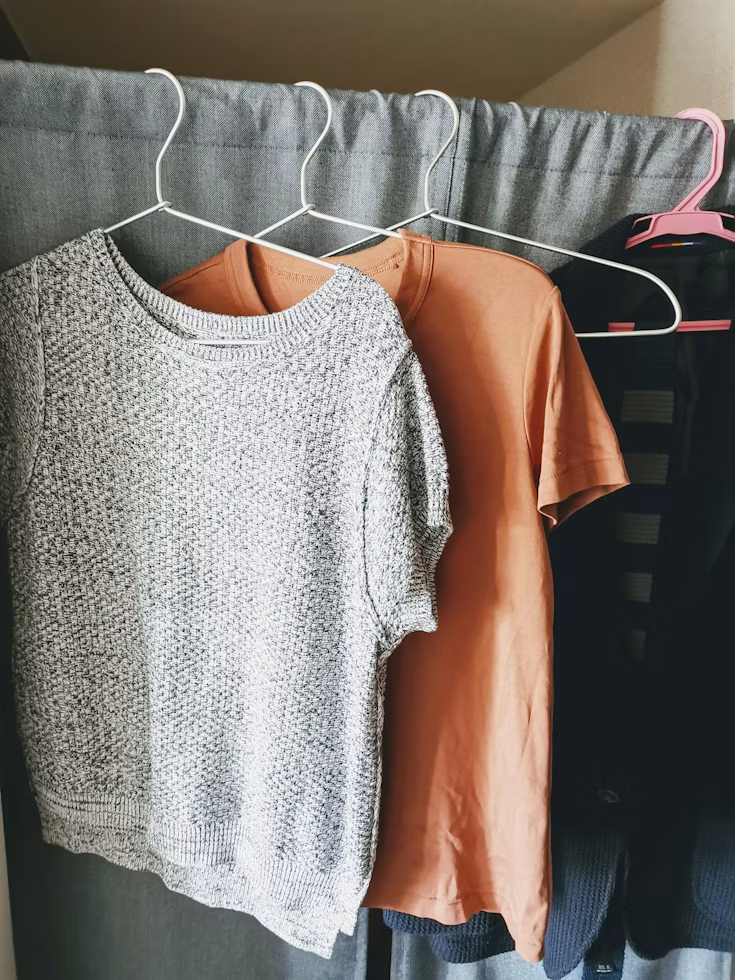
I used to do this every single season without fail. As soon as summer ended, I’d take everything out of rotation, shove it into vacuum bags or plastic boxes, and stack them in the back of the wardrobe. Six months later, I’d pull it all out like it was a mystery box — and then keep everything again, even the things I hadn’t touched once.
The problem is that storing without editing is just delaying the decision. Those items come back next season, take up space again, and the cycle repeats.
What actually helped me:
- Before storing anything, try it on — every single piece
- If you didn’t wear it this season, be honest about why
- Ask: would I actually reach for this next year, or am I just keeping it “just in case”?
The “just in case” pile is where closet clutter is born. A nice way to approach this is the seasonal wardrobe reset method — it forces you to consciously choose what earns a spot back in your rotation.
Storage Habit Comparison
| Habit | Result |
|---|---|
| Store everything without checking | Clutter returns every season |
| Try on before storing, discard what wasn’t worn | Closet stays manageable |
| Store only what you actively loved wearing | Only keepers come back |
Mistake 3. Treating Seasonal Sales Like an Obligation

End-of-season sales are genuinely dangerous if you have a “but it’s 70% off” problem. And I say this as someone who once bought a heavy wool coat in July because it was marked down and I told myself I’d “save it for winter.” I didn’t wear it for fourteen months. By the time I remembered it, I didn’t even like it anymore.
Sales aren’t savings if you’re buying things you wouldn’t have paid full price for. That’s just spending money slower.
The math people don’t do: if you buy five sale items you half-like for $20 each, that’s $100 spent and five items taking up space. Versus spending $60 on one piece you love and actually wear — which is the better deal?
Seasonal Sale Shopping: The Honest Math
| Scenario | Items Bought | Total Spent | Items Actually Worn | Cost Per Wear |
|---|---|---|---|---|
| 5 sale pieces @ $20 each | 5 | $100 | 2 | $50 per item |
| 1 considered purchase @ $60 | 1 | $60 | Many times | Drops every wear |
This table changed how I think about “deals.” Cost per wear is a much more honest calculation than sticker price.
Mistake 4. Keeping “Maybe Next Season” Items Too Long
We all have them. The skirt that’s slightly too small but you’re “going to fit into it.” The blazer that doesn’t quite work with anything you own but someday you’ll “find something to pair it with.” The shoes that hurt your feet but were expensive so they live in the box, waiting.
These items are the silent closet killers. They don’t go anywhere. They just sit, taking up physical and mental space — and every time you see them, there’s a tiny pang of guilt or hope that never quite resolves.
I kept a pair of heels for four years like this. Four years! Finally wore them to one event, remembered immediately why I never wore them, donated them the next morning. That’s four years of closet space I could have reclaimed.
The rule I now follow: If I haven’t reached for it in a full year — through every season — it goes. No exceptions for “but it’s expensive” or “but it’s barely worn.” Barely worn often means it doesn’t work for your actual life.
Mistake 5. Buying Trend Pieces Without Checking Your Existing Wardrobe

This is the one I see happen most often, and it’s how people end up with closets full of things that don’t go together.
You see a trend — wide-leg trousers, for example — and you buy three pairs in different colors because you love the look. But at home, your tops are all fitted and cropped, which is exactly what doesn’t work with wide-leg trousers. Now you need new tops to go with the trousers. And suddenly you’re shopping again.
Trend pieces almost always require supporting pieces, and that’s by design. Fast fashion thrives on this cycle.
Before buying any trend piece, ask three questions:
- Does this work with at least three things I already own?
- Am I buying this because I genuinely love it, or because I’ve seen it everywhere?
- Will this still feel relevant to me in two years?
If you can’t answer yes to at least two of these, put it back.
Building a wardrobe around pieces that genuinely connect is what separates a functional closet from a chaotic one. These 6 proven capsule wardrobe building tricks to reduce closet chaos are worth bookmarking if this resonates with you.
Mistake 6. Not Having a “One In, One Out” Rule
This sounds simple. Almost everyone knows about this rule. Almost no one actually follows it.
The reason it’s hard is because getting rid of something feels like a loss, even when you’re gaining something better. Your brain registers the outgoing item as a cost and the incoming item as a bonus — so psychologically, you end up with two items instead of one.
What helped me was reframing it: the new item doesn’t come home until the old one has already left. Physically. Not “I’ll donate this next week.” The bag goes in the car that day.
It also helps to keep a small “outbox” basket near your closet — a designated spot for items you’ve decided to let go. Once it fills up, you donate. That physical cue makes the habit easier to stick to than making a decision every time.
One-In-One-Out Success Rate by Method
| Method | Consistency Level | Closet Impact |
|---|---|---|
| Mental note only | Low | Minimal |
| Writing it down as a rule | Medium | Moderate |
| Outbox basket near closet | High | Noticeable |
| Outgoing item leaves same day | Very High | Significant |
Mistake 7. Seasonal Shopping Without a List (or a Budget)
Walking into a shop — or opening a shopping app — without knowing what you actually need is how impulse buys happen. And seasonal impulse buys are particularly sneaky because they feel justified. It’s a new season! You need new things! Except you probably don’t — you just haven’t looked at what you already have.
I started doing a quick wardrobe audit at the start of each season before buying anything. It takes maybe 20 minutes and it completely changed my shopping behavior.
Simple Seasonal Wardrobe Audit — 4 Steps:
Step 1: Pull out everything currently in rotation for that season. Lay it out or hang it where you can see all of it.
Step 2: Identify genuine gaps. Not “I want more options” — actual missing pieces. Like: I have no waterproof layer, or all my trousers are casual and I have a smart event coming up.
Step 3: Make a short, specific list. Not “tops” — something like “one lightweight long-sleeve in a neutral.” Specific limits what you actually buy.
Step 4: Set a budget before you shop, not after. Decide what you’re willing to spend total, not per item.
Apps like the Stylebook wardrobe organizer (iOS) or Whering (available on both iOS and Android) let you photograph and catalog your existing clothes so you can genuinely see what you have before shopping. It sounds extra, but even doing this once showed me I owned eight white tops. Eight. I thought I had maybe three.
The Bigger Picture: Why These Mistakes Keep Happening
All seven of these mistakes have one thing in common: they’re driven by emotion more than logic. Excitement about a new season, fear of missing a deal, guilt about money already spent, hope that something will eventually work. These are very human feelings, and the fashion industry is incredibly good at triggering all of them.
The good news is that once you can name the pattern, it gets easier to interrupt it. You don’t have to become a minimalist overnight or commit to a 30-piece wardrobe to stop the clutter cycle. You just have to slow down the moments when you’re most likely to add something without thinking.
How Seasonal Wardrobe Mistakes Accumulate Over Time
| Mistakes Made Per Season | Items Added (Estimate) | Items Actually Used | Unused Items Per Year |
|---|---|---|---|
| 1–2 mistakes | 5–8 items | 4–6 | 2–4 |
| 3–4 mistakes | 10–15 items | 5–8 | 5–10 |
| 5–7 mistakes | 15–25 items | 5–10 | 10–20 |
Over a few years, even moderate seasonal shopping mistakes stack up into a genuinely overwhelming closet. And the frustrating part is that most of those unused items cost real money that could have gone toward one or two pieces you’d actually love.
If you’re ready to reset rather than just declutter, the minimal wardrobe essentials guide is a solid place to recalibrate your whole approach.
Turning It Around: A Quick Seasonal Reset Plan
You don’t need a full weekend and a label maker. Here’s what actually works:
Week 1: Just observe. Don’t buy anything. Notice what you actually reach for each day and what you walk past without thinking.
Week 2: Edit your current season’s clothes. Set aside anything you haven’t touched. Box it up. If you don’t miss it in 30 days, it goes.
Week 3: Make your specific needs list. One or two genuine gaps, max. Not a wishlist — an actual needs list.
Week 4: Shop only from the list, with a set budget. Done.
This four-week rhythm, done at the start of each season, keeps things from spiraling. It takes maybe two hours of focused time spread across a month. The payoff — a closet you actually understand — is worth every minute of it.
Final Thoughts
The closets that fill up fastest usually belong to people who care the most about how they dress. That’s not a bad thing — it just means the intention is there but the system isn’t.
Once you stop making these seasonal mistakes, something genuinely nice happens: getting dressed stops feeling like a chore. You know what you have, you like what you have, and everything in your closet earns its place.
That’s the goal. Not perfection, not a Pinterest wardrobe — just a closet that works for you instead of against you.
Also worth reading: 7 Seasonal Wardrobe Secrets to Look Stylish Fast
Frequently Asked Questions
Q1: How often should I do a seasonal wardrobe edit?
Ideally, once at the start of each new season — so four times a year. It doesn’t have to be a big production. Even a 20-minute review of what you’re pulling into rotation and what you’re storing can make a huge difference over time. The more consistently you do it, the faster it gets.
Q2: What’s the best way to decide if something should be donated or kept?
The most honest test: if you pulled it out of a bag right now as if it were new, would you be excited to own it? If the answer is anything less than yes, that’s your answer. “Maybe” and “it’s fine” are just polite ways of saying no.
Q3: Is it okay to keep sentimental clothing even if I never wear it?
Yes — but give it a designated space that’s separate from your functional wardrobe. One small box of genuinely meaningful items is fine. The problem is when sentimentality becomes the reason everything stays, which is really just a harder-to-admit version of clutter.
Q4: How do I stop impulse buying during seasonal sales?
The most effective method is a 48-hour rule: add items to your cart but don’t check out. If you come back after two days and still want it — and it’s on your actual needs list — buy it. Most of the time, the urgency evaporates and you realize you didn’t need it at all.
Q5: Should I keep clothes that don’t fit right now, hoping they will later?
Keep them if the timeline is realistic and specific — like you’re actively working toward a goal and it’s a short window. But if “I’ll fit into this someday” has been your reasoning for more than a year, that item is occupying space and creating guilt without any real benefit. Let it go. If you get there, you can buy something new that fits the version of you at that time.
Sonnet 4.6